
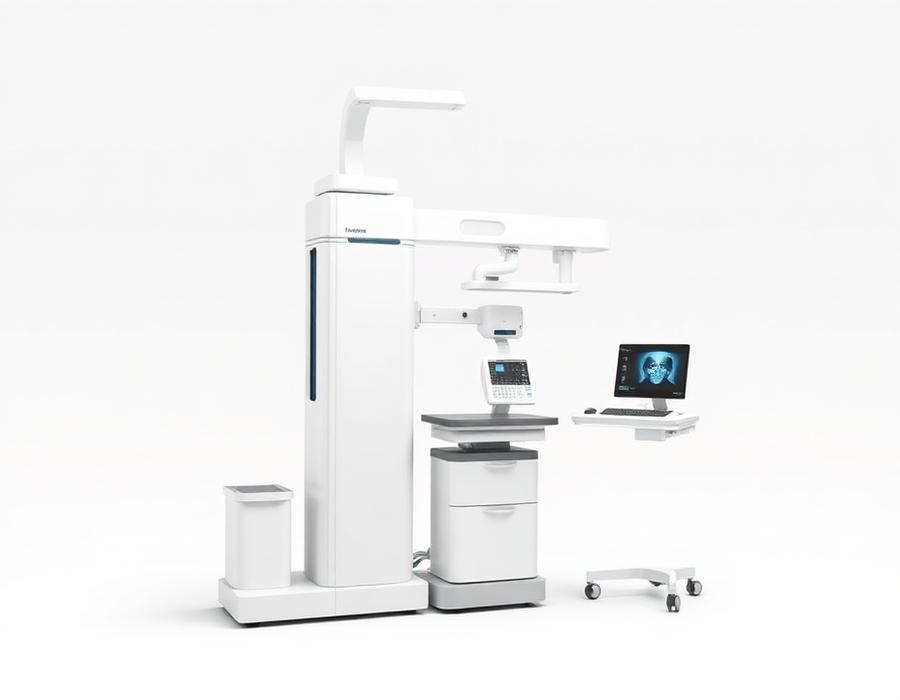
Start with case mix, not specifications
The right digital radiography configuration follows from the examinations a department actually performs. A high-throughput general radiography room, a trauma-facing casualty unit and an outpatient orthopaedic clinic place very different demands on positioning flexibility, generator output and detector handling.
Before comparing datasheets, document daily patient volume, the proportion of trolley and wheelchair patients, the most frequent projections and whether paediatric or bariatric imaging is routine.
Detector type and size
Flat panel detectors are broadly grouped into fixed panels built into a table or wall stand, and portable wireless panels that can be moved between the table, the bucky and a trolley.
Wireless panels add flexibility but introduce battery management, charging discipline and a higher risk of handling damage. Fixed panels reduce day-to-day handling risk but restrict positioning. Many departments settle on a mixed configuration: fixed panels in the bucky and table, plus one shared wireless panel.
Panel size selection usually comes down to 14x17 inch for general work, with a 17x17 inch option where chest, spine and cross-table projections are frequent.
Generator output and exposure control
Generator output is quoted in kW. Higher output shortens exposure time, which matters for chest imaging, paediatrics and any patient who cannot hold still. Confirm the kV and mAs ranges rather than relying on headline kW alone.
Automatic exposure control, anatomical programming and a dose-area product display support consistency between operators and simplify dose record keeping.
Room, power and shielding
Room dimensions determine whether a ceiling-suspended tube, floor-mounted column or straight-arm design fits. Ceiling suspension gives the widest reach but requires structural support and ceiling height.
Confirm three-phase or single-phase supply availability, earthing quality, air conditioning load and the shielding requirement in your regulatory approval. These items are frequently discovered late and delay commissioning.
Workflow and integration
Confirm DICOM worklist, store and print support, plus how images reach your PACS or reporting workflow. Where no PACS exists, plan for one at the same time; digital acquisition without archiving quickly becomes a bottleneck.
Ask how many acquisition workstation licences are included and whether image processing presets can be tuned locally.
Questions to include in your enquiry
Detector type, size and warranty terms; generator output and duty cycle; installation and room preparation responsibilities; regulatory documentation supplied; training days included; service response commitment and spare availability.
Share these points with us in a single enquiry and we can return comparable new and refurbished options rather than mismatched quotations.
This guide is educational only. Specifications, availability and regulatory status are confirmed per quotation and per unit.